





Plastic Crusher
| Place of Origin: | China |
| Brand Name: | POTHCARY |
| Certification: | CE |
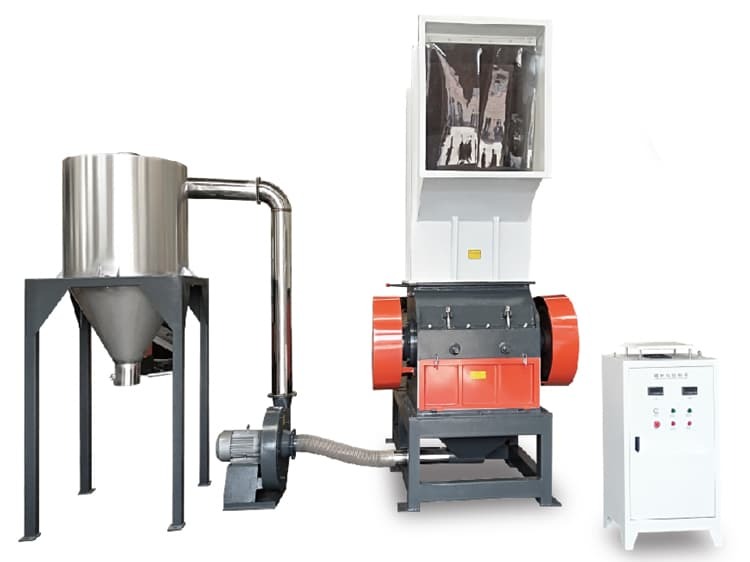
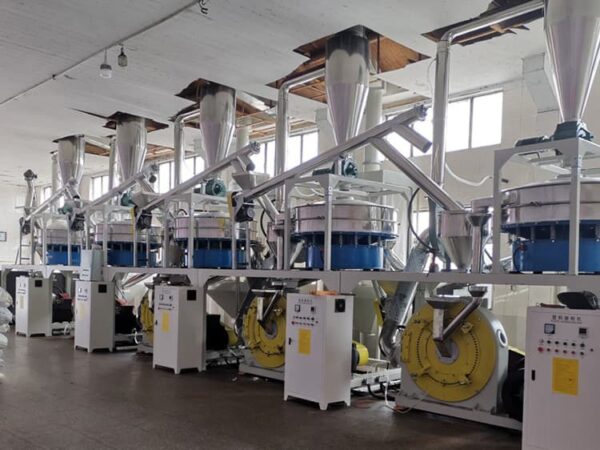
The crusher, also commonly referred to as a grinder or granulator, is primarily used for crushing waste plastics, plastic composites, and factory scrap. Based on the feed direction, it can be categorized into horizontal crushers with tangential feed and vertical crushers with top feed. According to the type of blades used, crushers can also be classified into V-blade crushers, flat-blade crushers, segmental-blade crushers, and hook-blade crushers. The crusher grinds various plastics and rubber into small pieces or flakes. The output can be directly fed as raw material to extruders or injection molding machines, or it can be further processed through extrusion and pelletizing for recycling.
The plastic crusher rapidly processes materials to the specified size through the continuously changing shear angle between the rotor and stationary blades, after which the material is filtered out by the bottom screen. Crushed waste plastic can be used for reprocessing, yielding high economic returns. The motor power of flat-blade plastic crushers ranges from 3.5 to 150 kW, with speeds typically between 150 and 500 rpm.
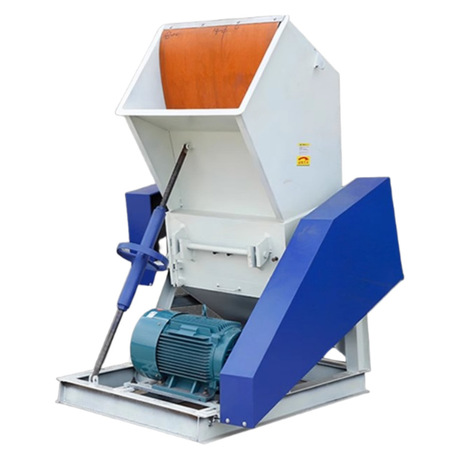
Plastic crushers deliver excellent crushing results and high efficiency for PET, PVC, and PE plastic bottles; PE plastic film; PVC sheets; PE pipes; plastic drums; plastic crates; injection molded parts; and other materials in bottle, sheet, board, lump, or chunk form. The equipment features a reinforced main shaft, a robust crushing chamber, and a hydraulic automatic feed mechanism, which collectively improve the material crushing process within the machine. Equipped with high-hardness blades and a carbon steel welded feed inlet, it can crush long PVC pipes effectively. Designed for convenient automatic feeding and resistance to blade wrapping, it is commonly used for PVC sheets, PVC pipes, PE films (e.g., bubble wrap, agricultural film, stretch/cling film), fabrics (e.g., fishing nets, acoustic insulation cotton), and similar materials.
The plastic crusher operates by using an electric motor to drive the blade rotor at high speed. During the rotor’s high-speed rotation, a relative motion is created between the rotor blades and the stationary blades. The gap formed between them generates a shearing action that cuts and breaks down large plastic pieces. The crushed plastic is then sieved through a screen to filter particles to the desired size, making the entire process efficient and labor-saving. For processing thin plastic films or woven bags, an integrated fan can be used to create directional airflow within the chamber, reducing discharge resistance and increasing equipment throughput.
-
Chamber: Constructed from manganese steel (cast or welded depending on the model) for wear resistance and high impact strength. The bearing housings on both sides are precision machined as integrated assemblies to ensure smooth equipment operation.
-
Main Shaft: Made from alloy material and machined on a lathe to ensure shaft precision and reduce bearing wear.
-
Blade Holder (Cutter Hub): Common types include welded and cast versions (selected based on specific industry processing needs).
-
Blades: Commonly used blade materials include: 9CrSi, carbide-tipped, SK5, T10, 6CrW2Si, Cr12MoV, etc.
-
Hopper: Designed with a curved arc principle to enclose the feed inlet spatially, preventing material from splashing back out of the main chamber.
-
Electrical Control Unit: (Optional installation depending on motor configuration). The main electrical system primarily consists of three-phase AC contactors, limit switches, thermal circuit breakers, and other components.
-
Screen: The crusher screen is mainly made by stamping manganese plate to ensure wear resistance.
-
Lower Frame/Housing: The lower housing is primarily used to mount the motor, define the discharge flow direction, and provide support for the upper housing.
-
Before starting, manually rotate the drive pulley one or two revolutions to confirm free movement before powering on. Begin feeding material only after the crusher is running normally.
-
Before stopping, first halt material feed and ensure all material inside the machine is discharged, then cut off the motor power.
-
During operation, monitor bearing temperature, ensure bearings remain well-lubricated, and pay attention to any abnormal sounds or vibrations. If irregularities are detected, stop the machine to check for jamming by non-crushable objects or for component damage.
-
Maintain consistent feeding to prevent overload. Strictly prevent non-crushable objects like metal and wood from falling into the machine. When crushing difficult materials, ensure feedstock moisture content is not excessively high. For wet crushing processes, maintain adequate water flow to prevent clogging due to insufficient flushing, which can reduce production capacity.
-
Check if the particle size of the crushed product meets requirements. If an excessive amount of oversized particles is present, identify the cause (e.g., oversized screen gaps, too wide discharge opening, worn hammers/blades) and take appropriate corrective measures.
-
When the crusher is stopped, inspect whether fastening bolts are secure and assess the wear level of high-wear components. For toothed crushers, also use shutdown opportunities to remove any wood or debris lodged between the teeth.
-
Worn parts should be replaced or repaired promptly.
-
Keep the crusher’s safety protection devices in good condition. Do not disable safety devices for the sake of convenience.
您必须登录才能发表评价。
目前还没有评价
您必须登录才能发表评价。


评价
Clear filters目前还没有评价