


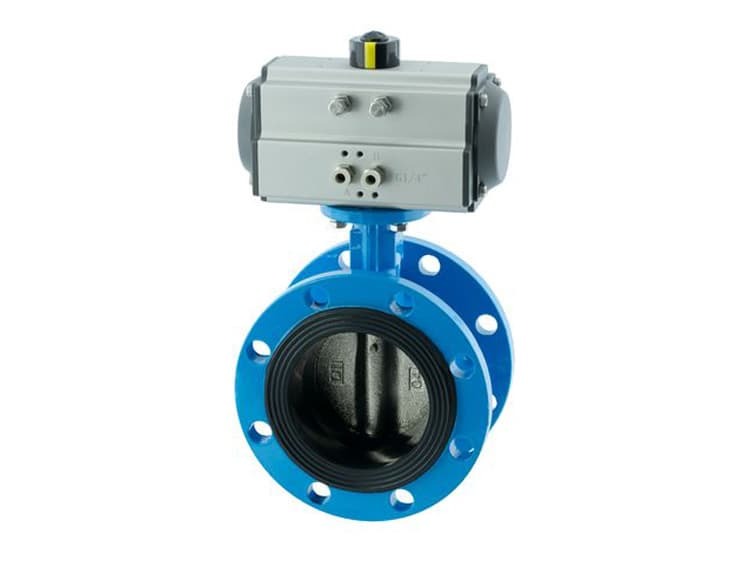


Pneumatic Butterfly Valve
| Place of Origin: | China |
| Brand Name: | POTHCARY |
| Certification: | CE |
The Pneumatic Butterfly Valve consists of a pneumatic actuator and a centerline butterfly valve. Equipped with limit switches, solenoid valves, an air filter-regulator-lubricator (FRL) unit, and a 0.4-0.7 MPa air supply, it performs on/off operations and provides a pair of passive contact signals to indicate valve status. When paired with an electro-pneumatic positioner and supplied with a 4-20mA DC signal and the same air source, it enables intelligent proportional control. Powered by compressed air, the valve stem rotates the disc by 90° within the valve body to achieve a full open-to-close cycle. This valve offers advantages like compact structure, small size, reliable operation, good sealing, easy maintenance, simple installation, and strong adaptability. It is widely used for remote centralized or local control in automatic systems across industries like plastics, petroleum, chemicals, light industry, pharmaceuticals, paper, and automotive.
Utilizes a pneumatic actuator, available in double-acting and single-acting (spring return) types with gear transmission for safe, reliable operation. Larger diameter valves use the AW-type pneumatic actuator with fork-type transmission, offering a rational structure, high output torque, and both double/single-acting options.
For powder systems, consider factors such as preventing material from directly impacting the disc (which can hinder tight sealing) and ensuring the material’s static pressure does not exceed the valve’s design pressure rating.
The Pneumatic Butterfly Valve operates by rotating a stem that turns a disc to open or close the flow path. The disc is installed along the pipeline’s diameter. Inside the valve’s cylindrical bore, the disc rotates on an axis through an angle of 0° to 90°, reaching full open at 90°. When open, the disc thickness presents minimal resistance to flow, resulting in a low pressure drop and good flow control characteristics. The Pneumatic Control Butterfly Valve uses an air supply to adjust the disc angle, thereby controlling media flow. It is an assembled unit comprising the butterfly valve, a pneumatic actuator, a valve positioner, and other accessories.
Actuators are either Single-Acting (spring-return) or Double-Acting. Single-acting types are air-to-close/spring-to-open or air-to-open/spring-to-close, suitable for normally open or normally closed applications. Double-acting types require air pressure for both opening and closing motions. Control valves typically use double-acting actuators.
-
Pneumatic Flanged Butterfly Valve: Combines a rubber-sealed butterfly valve with a carbon/stainless steel disc and stem. For temperatures <80~120°C in food, chemical, petroleum, power, textile, paper, etc., for flow regulation and shutoff in water/gas pipelines.
-
Pneumatic Control Butterfly Valve: A valve where the disc rotates around an axis perpendicular to the flow path. Consists of a piston-type double-acting or single-acting (spring return) pneumatic actuator and a butterfly valve. It’s a high-performance rotary control or shut-off valve. With an electro-pneumatic positioner or solenoid valve, filter-regulator, and limit switch, it enables proportional control or on/off shutoff for automated control of flow, pressure, temperature, and level.
-
Pneumatic Wafer Butterfly Valve: Features a novel, compact wafer-style body for installations with limited space. External leakage is prevented.
-
Pneumatic Rubber-Lined Butterfly Valve: Connection types: flanged or wafer. Lining materials include Nitrile Rubber (NBR), EPDM, Heat-resistant EPDM, Natural Rubber (NR), Neoprene (CR), Fluororubber (FKM), PTFE. Selection depends on the medium’s chemical properties.
-
Pneumatic Fluorine-Lined Butterfly Valve: The anti-corrosion fluorine-lined valve has a split body. The seat is integrated with the fluorine liner. During operation, only the fully plastic seat and lined disc contact the medium. It resists corrosion from any medium except “molten alkali metals and elemental fluorine.” Models like D71F46 have a disc/forged stem as one piece, uniformly coated with FEP. The smooth bore offers low fluid resistance, high Cv value, and strong flow capacity. It uses a four-stage sealing structure with an elastic rubber seat for zero leakage.
-
Pneumatic Ventilation Butterfly Valve: Features a small gap between disc and seat. Suitable for environments with poor air circulation.
Application Fields
Food, Chemical, Petroleum, Power, Municipal Construction, Metallurgy, Pharmaceutical, Beverage, etc.
Suitable for pipelines conveying corrosive or non-corrosive fluids in systems like gas generators, coal gas, natural gas, LPG, city gas, hot/cold air, chemical smelting, and power generation, for flow regulation and shutoff.
Application Materials
PVC powder, lime powder, calcium powder, plastic pellets, etc.
Application Conditions
Can control various fluids including water, air, steam, natural gas, foodstuffs, pharmaceuticals, oils, corrosive media, slurries, liquid metals, and radioactive media within a working temperature range of -10°C to 150°C.
Suitable for applications requiring complete sealing (zero leakage in gas tests) and high service life.
Pneumatic Wafer Soft-Seal Butterfly Valves are for temperatures ≤120°C or ≤150°C. Pneumatic Wafer Hard-Seal Butterfly Valves are for temperatures up to 200°C or 450°C and nominal pressures ≤1.6 MPa. Used in water supply/drainage, sewage, food, heating, gas, shipping, hydropower, metallurgy, energy systems, and light textile industries. Particularly suitable for bidirectional sealing and applications prone to valve body corrosion, for flow regulation and shutoff.
-
Keep the valve clean during use. Lubricate the drive thread periodically. Stop use immediately upon failure, identify and clear the cause.
-
Tighten the gland bolts evenly to avoid tilting, which could hinder stem movement or cause leakage.
-
Install directly on the pipeline per connection type. It can generally be installed in any position convenient for operation and maintenance. Note: Globe valve media should flow from below the disc upwards. Lift-check valves must be installed horizontally.
-
Use the valve only in fully open or fully closed positions. Do not use for throttling to avoid seal erosion and accelerated wear. Gate valves and globe valves have back-sealing; tightening the handwheel to the top position prevents media leakage from the packing.
-
Operate the valve using the handwheel only. Do not use levers or other tools to avoid damage. Clockwise rotation closes, counter-clockwise opens.
-
Before installation, verify the valve’s pressure rating and diameter meet requirements. Remove any transport defects and clean the valve.
-
For long-term storage, inspect periodically. Keep machined surfaces clean and free of dirt. Store ball valves open with ends plugged. Store butterfly valves closed with ports capped. Keep neatly indoors in a dry, ventilated area. Do not pile or store outdoors.

-
Before installation, check all parts are present, model is correct, valve body is free of debris, and solenoid valve/silencer are unblocked.
-
Ensure both the valve and actuator are in the closed position.
-
Mount the actuator to the valve (parallel or perpendicular orientation is acceptable). Align screw holes; minor misalignment can be corrected by slightly rotating the actuator body before tightening.
-
After installation, perform调试 (commissioning) (normal air supply: 0.4~0.6 MPa). Test manually via the solenoid valve (de-energize the coil first). Observe valve operation. If initial movement is stiff, reduce the actuator stroke (adjust both end stroke screws inward slightly with valve open and air off) until smooth. Note: Adjustable silencers control speed but should not be set too low, preventing action.
-
Valves should be stored dry before installation, not outdoors.
-
Inspect the pipeline before installation, ensuring it’s free of welding slag or other debris.
-
Manual operating force should be moderate. Valve torque must match the selected actuator’s torque.
-
Flange specifications must be correct. Pipeline flanges must match the valve flange standard. Use butterfly valve specific flanges, not slip-on flanges.
-
Ensure flanges are welded correctly. Do not weld flanges after valve installation to avoid damaging rubber parts.
-
Align the installed pipeline flanges and center them with the valve.
-
Install all flange bolts hand-tight. Verify the valve is centered, then operate it gently to ensure smooth action.
-
Fully open the valve. Tighten bolts diagonally with a wrench—no gasket needed. Do not overtighten, as this can severely deform the seat, increasing operating torque.
Valve Positioner Composition and Classification
The valve positioner is a key accessory for pneumatic control valves, functioning as a proportional amplifier. Together with the valve, it forms a travel control system primarily comprising a pneumatic capacitance and a lag element. By structure and principle, they are: Pneumatic, Electro-Pneumatic, and Intelligent Valve Positioners.
Functions:
-
Eliminate hysteresis.
-
Eliminate signal mismatch.
-
For composite control systems.
-
Enable reverse action.
-
Operate non-standard actuators.
-
Pneumatic Positioners: Accept a pneumatic signal from a controller and produce a proportional output pressure to control the valve. Types: Displacement-balance and Force-balance.
-
Electro-Pneumatic Positioners (Used with Pneumatic Butterfly Valves): Accept a DC 4-20mA signal to control the actuator. They function as an I/P converter and positioner. They provide feedback based on actuator travel for precise positioning per the control signal.
-
Intelligent Positioners: A microprocessor compares setpoint and actual position. Based on the control deviation, it outputs an electrical command to a piezoelectric valve, which converts it to a pneumatic positioning increment. Output can be continuous (large deviation), pulsed (moderate), or none (small).
Accessory Selection:
-
Main accessories: Positioner, Converter, Relay, Booster Valve, Lock-up Valve, Pressure Regulator, Filter, Lubricator, Limit Switch, Position Transmitter, Solenoid Valve, Handwheel.
-
Accessories supplement function and ensure operation. Add only necessary ones. Unnecessary accessories increase cost and reduce reliability.
-
A positioner’s main role is to increase output force and speed. If not needed, omit it.
-
For fast response without needing fast valve action, a converter may suffice.
-
For strict explosion-proof areas: I/P Converter + Pneumatic Positioner.
-
Choose reliable solenoid valves.
-
For critical applications, avoid handwheels to prevent manual misuse.
-
Accessories should be supplied and assembled by the manufacturer for system reliability.
-
When ordering, provide accessory name, model, specification, input/output signals.
您必须登录才能发表评价。
目前还没有评价
您必须登录才能发表评价。

评价
Clear filters目前还没有评价