


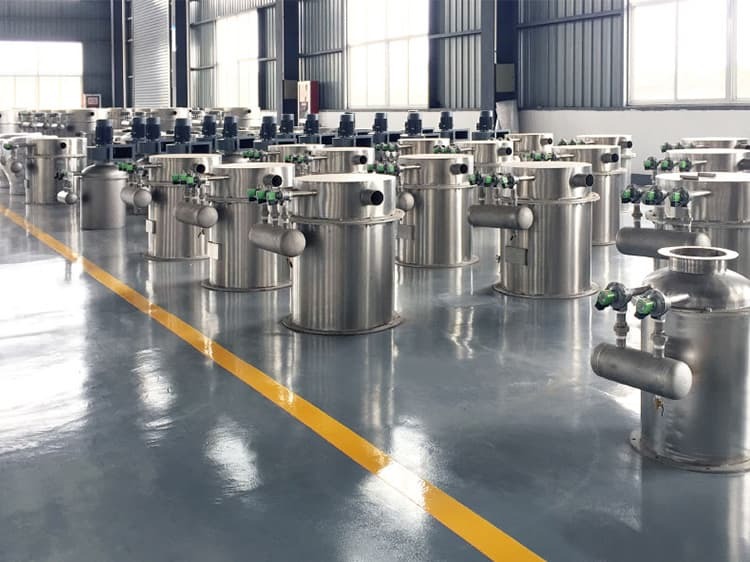


Pulse Jet Dust Collector
| Place of Origin: | China |
| Brand Name: | POTHCARY |
| Certification: | CE |
The Pulse Jet Dust Collector is an improved design based on the baghouse filter. It consists of an air inlet, filter cartridge (or bag compartment), air outlet, air reservoir (air tank), pulse controller, pulse valves, and blowpipes. This equipment offers advantages such as high purification efficiency, large gas handling capacity, stable performance, long filter bag life, easy operation, and minimal maintenance requirements. Pulse Jet Dust Collectors are widely used in industrial and mining enterprises including cement, mineral powder, metallurgy, building materials, machinery, chemicals, and grain processing. They are employed for filtering fine, non-fibrous, dry dust from gases or for recovering dry powder materials within industrial processes.
In operation, dust-laden gas enters the collector through the inlet and first encounters baffles or deflectors, causing the airflow to change direction into the hopper while slowing down. Due to inertia, coarser dust particles fall directly into the hopper, serving as pre-collection. The airflow then turns upward, passing through filter bags supported by metal cages. Dust is captured on the outer surface of the bags, and the cleaned gas enters the clean air plenum above the bag compartment, converging at the outlet for discharge. As dust accumulates on the bags over time, resistance increases, reducing the air handling volume. To maintain normal operation within a set resistance range, the bags must be cleaned periodically. During cleaning, the pulse controller sequentially triggers the pulse valves. Compressed air from the reservoir is injected through blowpipe nozzles into the corresponding bags, causing them to expand rapidly and dislodge the dust. The dust falls into the hopper and is discharged via the ash removal system. This periodic pulse-jet cleaning ensures continuous gas flow and stable system operation.
-
Casing: Includes the bag compartment, clean air plenum, tube sheet (for bag attachment), filter bags, bag cages, and access doors.
-
Pulse Jet System: Consists of the main air supply pipe, blowpipes, pulse valves, and the controller.
-
Ash Discharge System: Includes the ash discharger (rotary valve), discharge valve, and screw conveyor for conveying collected dust.
The Pulse Jet Dust Collector removes dust from the filter medium (bags or cartridges) by injecting pulses of compressed air. Depending on the collector’s size, multiple sets of pulse valves are controlled by a pulse timer or PLC. One set opens at a time to clean its assigned section of bags/cartridges while others remain in operation. After a set interval, the next valve group activates.
The collector comprises a hopper, lower casing, middle casing (filter chamber), and upper casing (clean air plenum), often designed as compartmentalized modules. During operation, dust-laden gas enters the hopper via the inlet duct. Coarse particles fall directly into the hopper bottom, while finer particles follow the airflow into the filter chamber(s). Dust adheres to the outer surface of the bags. Filtered gas enters the clean air plenum and is discharged via the outlet duct and fan.
The cleaning process involves isolating a compartment by closing its clean air outlet, stopping airflow through those bags (compartmentalized, offline cleaning). Then, pulse valves open for compressed air injection. The isolation valve remains closed long enough for dislodged dust to settle into the hopper, preventing re-entrainment onto adjacent bags, ensuring thorough cleaning. A Programmable Logic Controller (PLC) typically automates the outlet valves, pulse valves, and ash discharge valves.
-
Employs compartmentalized, offline pulse-jet cleaning technology, overcoming drawbacks of conventional online pulse or reverse-air collectors. It offers powerful cleaning, high efficiency, low emissions, low air leakage, reduced energy and steel consumption, small footprint, reliable operation, and strong economic benefits. Suitable for dust collection and material recovery in metallurgy, building materials, cement, machinery, chemicals, power, and light industries.
-
Offline cleaning allows effective cleaning in a single pulse, extending cleaning cycles, reducing compressed air consumption, and lessening fatigue on bags and valves, thereby extending their service life.
-
Bag inspection and replacement can be performed compartment by compartment while the system fan and other compartments remain operational. The bag opening uses a spring tension ring for an excellent, secure seal. Multi-sided bag cages reduce friction with bags, extending bag life and easing removal.
-
Top bag removal design: When replacing bags, the cage is extracted, and the used bag drops into the lower hopper for removal via an access door, improving working conditions.
-
Airtight casing design with high-quality sealing materials for access doors, checked for leaks during manufacturing, ensures very low air leakage.
-
Compact inlet/outlet duct design minimizes airflow resistance.
The Pulse Jet Dust Collector, with its offline pulse-jet cleaning, combines the strengths and avoids the weaknesses of reverse-air and standard online pulse cleaning. It features powerful cleaning, high efficiency, low emissions, low leakage, low energy use, small footprint, and reliable operation. It is particularly suited for applications characterized by high temperatures and large gas volumes, such as:
-
Calcium carbide furnace dust collection
-
Ferroalloy plant electric furnace dust collection
-
Steel plant flue gas purification
-
Coal-fired boilers and small power plant boilers
-
Waste incineration flue gases
-
High-temperature smelter off-gases
-
Aluminum plant gas purification
-
Cement plant rotary kiln inlet/outlet gases
-
Carbon black plant tail gases
-
Assign dedicated personnel to manage operations and maintain logs.
-
Managers must understand the collector’s principles, performance, operating conditions, parameter adjustment, and maintenance procedures.
-
Regularly lubricate all designated points.
-
Frequently check the pulse-jet system. If abnormal, inspect pulse valve diaphragms and solenoid valves for failure/damage and repair/replace promptly.
-
Troubleshoot pulse valve issues immediately. Clean internal contaminants/water; replace damaged diaphragms.
-
Regularly inspect cylinder seals and flange gaskets. Replace seals if leaking.
-
Replace aged gaskets on inspection doors.
-
Periodically measure process parameters (gas volume, temperature, dust concentration). Investigate and address anomalies.
-
Monitor system pressure drop fluctuations to assess normal operation.
-
Filter bags are wear parts. Regularly inspect their condition and replace based on wear.
-
Regularly check the air supply system and ash discharge system; troubleshoot abnormalities.
-
Periodically drain water from the compressed air system moisture separator.
-
At shutdown, keep the collector and fan running for a period after process stop to purge moisture and residual dust. Perform repeated cleaning and ash discharge cycles before final shutdown.

您必须登录才能发表评价。
目前还没有评价
您必须登录才能发表评价。

评价
Clear filters目前还没有评价